

The number of dealerships in the U.S. has declined by about 25% since 1990, according to data from Urban Science. Over the same period, throughput has risen by more than 50%. Dealers are being asked to serve more customers with fewer locations, putting increased pressure on service departments.
Meanwhile, in Europe, new entrants are rapidly reshaping the market, particularly in the electric and hybrid segments. The shift has not yet fully taken hold in the U.S., but industry sentiment suggests it is a matter of when—not if—new entrants begin gaining a foothold in the market. A sales launch is only the beginning of a broader network strategy for new entrants. Every vehicle sold creates a service obligation, meaning a well-structured service network could be the determining factor between long-term success and failure.
As networks evolve and aftersales expectations remain high, capacity planning—the process of determining the optimal service department infrastructure—has become a strategic imperative for legacy brands and new entrants alike. Capacity planning provides the foundation for an accessible, convenient service network by tailoring service infrastructure to both current and projected demand.
A Multi-Layer Approach to Network Capacity
Service demand behaves differently from sales demand. There are limits to how far most customers are willing to travel to service their vehicles. In the 2026 Urban Science Harris Poll Study*, 45% of respondents said they strongly agree they are less likely to travel far for service than they are when shopping for a car. To account for this preference and maintain service loyalty, original equipment manufacturers (OEMs) and dealers need to find ways to offset reduced proximity to traditional service locations with increased convenience. One option is offering new service alternatives, such as mobile service and concierge programs. This scenario is one of several factors underscoring the need for a more comprehensive approach to capacity planning—one that considers multiple layers of capacity:
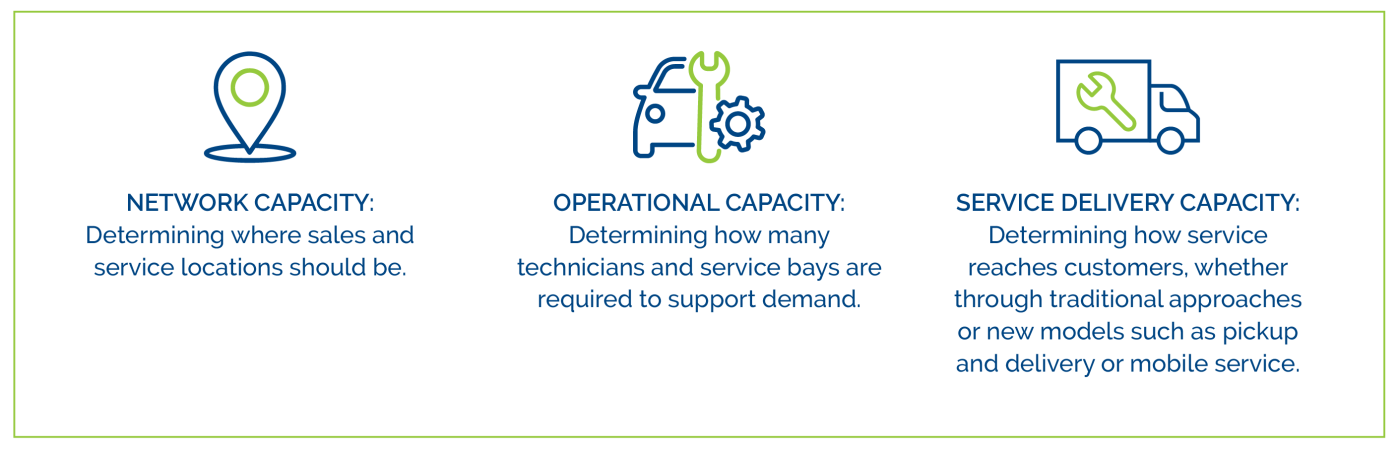
Technician hours are the core unit of capacity for the service drive. OEMs and dealers may be unable to take on as many repair orders or specific types of work, limiting service throughput if a network lacks sufficient technicians or productive hours. The nature of service itself is also changing as new electrified powertrains shift service demand toward advanced diagnostics and electronics. In light of this, OEMs and dealers must now consider not only how many technicians they need, but also whether those technicians have the skill set to service an evolving vehicle mix.
Forecasting Demand to Right-Size Service Capacity
Effective capacity planning requires a long-term, data-driven approach that allows OEMs to anticipate and plan for service demand years ahead. The first step is looking at vehicle units in operation (UIO). This metric represents the total vehicle population in a given market area or geography. Automakers and dealers can use UIO to estimate service demand based on vehicle age, type and powertrain mix. Demand can then be translated into required technician hours, service bays and infrastructure.
Along with forecasting UIO, it’s also important to consider when different types of service require additional delivery models. Routine maintenance can often be delivered through mobile or distributed service approaches, while more complex repairs call for fully equipped facilities and specialized expertise. Building an effective aftersales network depends on understanding how these elements come together to inform local service demand and capacity.
Part of capacity planning is simply revealing untapped opportunity. Many dealerships are profitable even when they lack sufficient service capacity. As a result, dealers may not feel a sense of urgency to invest in additional service infrastructure. However, those dealerships may be capturing only a small portion of service demand within their primary market area (PMA), while the rest is lost to independent repair shops or other dealerships. Capacity planning can reveal how much incremental revenue could be unlocked through targeted investments in technicians and service bays. Once dealers understand the total service demand in their PMA, they can use this information to expand capacity and, in doing so, increase revenue, improve customer retention and pave the way for future vehicle sales.
Capacity Planning as a Growth Lever
Expanding facilities, hiring technicians and training staff can take years. In fact, some of the most proactive dealers are investing in technician education well in advance by partnering with local schools and community colleges to build recruitment pipelines. Automakers and dealers need to begin preparing long before demand changes become visible in the market in order to support these kinds of forward-looking investments. Preparation depends on having the right data and using it effectively. Combining OEM-level data with local demand signals, such as UIO, enables a clearer understanding of how the aftersales market is evolving.
OEMs must fully align network and capacity planning rather than treating sales and service as two separate functions. Automakers that make capacity planning an ongoing part of their network strategy will be better positioned to maximize service performance and capture a greater share of available service demand. Those who don’t risk leaving opportunity and revenue on the table.
Ready to unlock your network’s full-service potential? Connect with Urban Science to discuss how our suite of solutions can support a data-driven approach to network optimization.
