
Automotive retail network planning has never been simple. Original equipment manufacturers (OEMs) have always balanced coverage, performance and profitability when planning their dealership and service networks. But today, automakers have more factors to consider than ever, thanks to fluctuations in powertrain, alternative retail formats and new aftersales needs across their customer segments.
Key pressures shaping modern automotive network strategy include:
- Electrification and EV readiness requirements
- ARFs and digital purchase journeys
- Evolving aftersales and service delivery models
- Competitive pressure from new market entrants
New powertrains and ARFs are not just adding complexity — they’re fundamentally changing how automotive networks must be planned and supported to drive efficiency and profitability across locations. EV readiness requires additional infrastructure, training and investment requirements across markets, while ARFs are often deployed selectively to test demand or establish early market presence. These formats are often paired with digitally enabled journeys connecting physical and online touchpoints that seamlessly guide consumers from inquiry to purchase.
Aftersales coverage is also evolving. Service-only locations, mobile service and other convenience-led initiatives are expanding how high-margin service offerings can be delivered as part of a broader automotive retail and service network strategy. Meanwhile, established OEMs face growing pressure from new market entrants building networks from scratch, often at significant speed and in unfamiliar environments. This situation underscores the need for OEMs to look beyond immediate disruption and adopt science‑driven, long‑range network planning that enables them to compete over the next decade as customer choice continues to expand.
Together, these dynamics solidify the need for OEMs to make faster, more informed and more confident network decisions that sustain competitiveness well beyond initial market entry by new players.
Viewing Automotive Network Strategy Through a Lifecycle Lens
Examining the OEM network lifecycle helps explain how competitive and operational pressures manifest over time and why network strategy must adapt as brands and markets evolve. For OEMs entering a new market, early network decisions often tend to focus on establishing a presence and building awareness. In these phases, automakers may leverage multiple strategies simultaneously to reach consumers. This can include taking over dealership locations when competitors exit a market and using alternative retail formats to increase brand recognition.
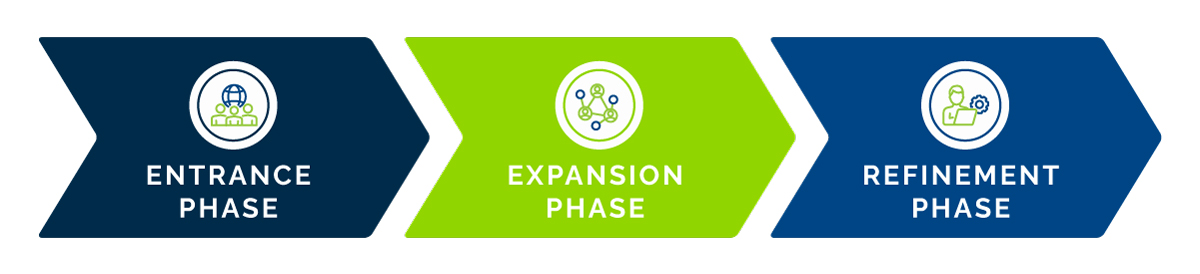
In the entrance phase, automakers need visibility into market potential, competitor activity and geographic coverage. They need to understand where demand exists, how their footprint compares to competitors and how to avoid overextending or misaligning the network with customer expectations.
As networks expand, complexity grows. In this stage, strategic focus shifts from growth alone to managing the network cohesively, ensuring coverage, profitability and the customer experience remain aligned across regions and formats. Rather than simply following competitors, OEMs in this phase may begin pioneering new locations or formats. This approach requires a deep understanding of customer demand, market readiness and network performance at a system level — and the ability to translate that insight into clear, forward‑looking decisions.
Once networks reach full maturity, priorities often shift again. Factors such as rising costs, changing consumer behavior and uneven performance across locations can all prompt an OEM to refine its footprint through consolidation, territory rebalancing or the creation of larger, more efficient entities. At this stage, network strategy is focused less on expansion and more on maintaining long-term resilience and profitability.
Across all these phases, one theme holds true: effective automotive network planning depends on understanding how individual decisions affect the broader system. Evaluating locations, formats or markets in isolation is no longer sufficient in an environment defined by interconnected change.
Urban Science helps OEMs navigate every stage of the network lifecycle by applying proven automotive network science to real‑world decision‑making. Combining decades of global OEM experience with advanced analytics, predictive modeling and scenario‑based planning, Urban Science moves beyond descriptive data to deliver decision‑ready insights. This system‑level approach enables automakers to evaluate markets, locations and formats in context—supporting smarter investment, stronger network performance and long‑term competitiveness in an increasingly complex and evolving automotive retail landscape.
Visualizing and Evaluating Automotive Network Potential
As automotive network strategy becomes more complex, planning tools need to support a broader and more interconnected set of considerations. OEMs weighing changes to retail or service footprints need the ability to visualize multiple site types, ownership relationships and geographic layers to understand how a shift in one area could affect the rest of the network.
To address this, many automakers are investing in advanced planning tools, such as Urban Science’s new NetworkPlanner™, which supports system-level planning across multiple stages of network maturity. The solution allows users to visually explore myriad network scenarios including dealerships, competitor locations and other points of interest to assess overall network health. OEMs can quickly and efficiently evaluate the impact of non-traditional retail models, including pop-ups and service-only or mobile offerings, within their networks to make high-stakes business decisions rooted in science, not speculation.
The platform also allows users to visualize dealer territories using mile rings and distance measures to ensure balanced coverage and convenient customer access. Automated aggregation of performance metrics across geographic levels delivers faster, more accurate reporting for strategic and operational decisions. Meanwhile, key performance indicator (KPI) overlays help users to analyze competitive pressure and market saturation. What distinguishes tools like NetworkPlanner is their ability to accommodate network planning needs of all market sizes and business models, whether an automaker is defining its initial footprint, managing multi-format expansion or refining an established network.
Building a Smarter, Science-Driven Automotive Network
Regardless of an OEM’s size, tenure or geographic reach, automotive network strategy remains a critical lever for long-term success. While the challenges facing legacy automakers differ from those facing newer brands or market entrants, each scenario demands data-backed, scientific decision-making. Choices around network coverage and retail or service formats require more than intuition or precedent. They demand methodologies grounded in timely, accurate data and informed by robust industry expertise.
In today’s environment, a successful automotive network strategy depends on aligning network design with market readiness, customer demand and long-term operational resilience. OEMs that adopt a system-level approach to network planning are better positioned to navigate change — transforming network complexity into a sustained competitive advantage
Ready to make smarter, faster and more confident decisions across your entire network lifecycle? Connect with Urban Science to find out more about Network Planner.
